How to Choose the Right Air Compressor Size for Your Workshop (CFM & PSI Guide)
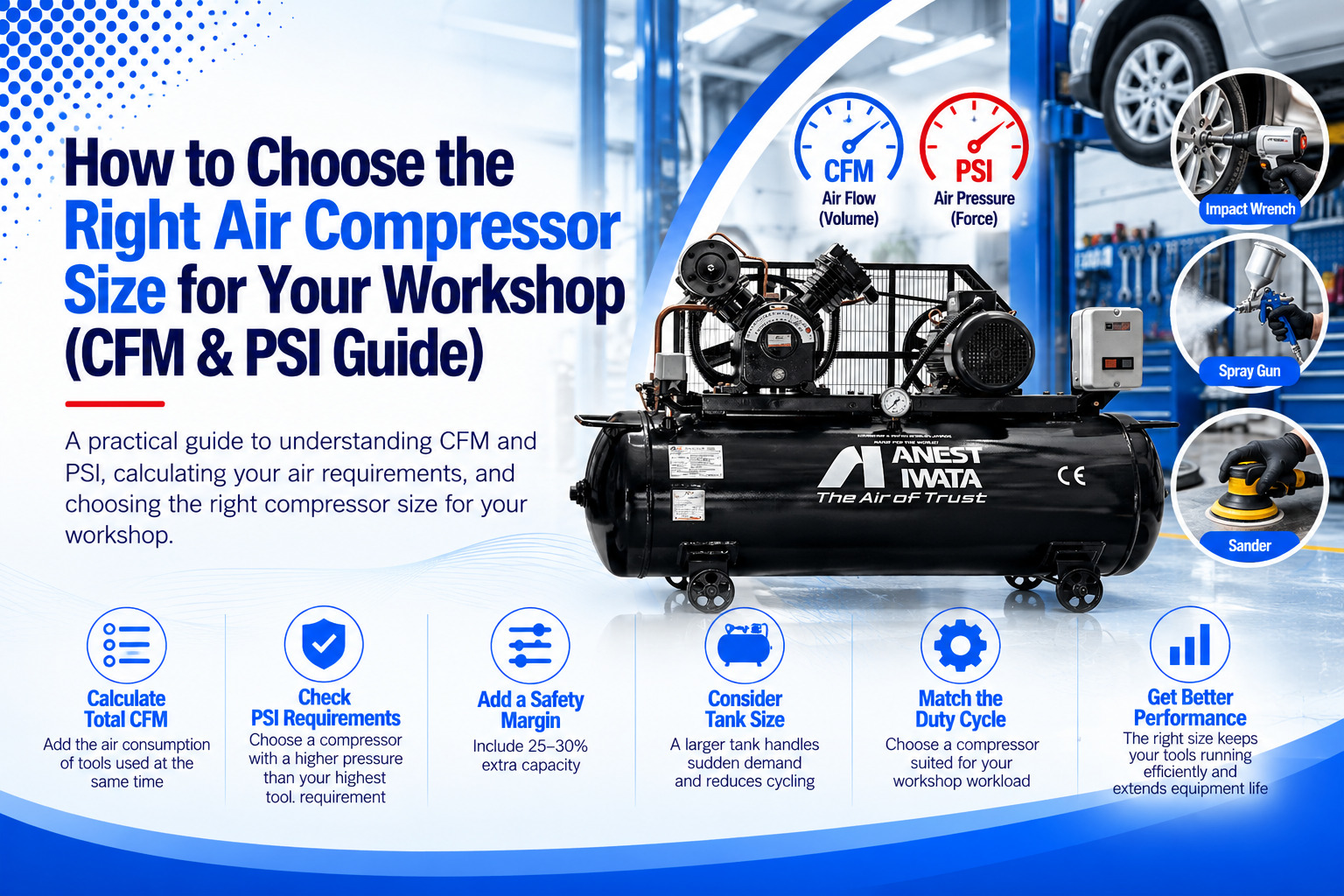
Quick answer: To choose the right air compressor size, add up the air consumption (CFM) of the tools you run at the same time, add a margin of around 25 to 30 per cent, and check that the compressor’s pressure (PSI or bar) is above the highest pressure any tool needs. Tank size and duty cycle then decide how smoothly it copes with real working conditions.
Picking a compressor by horsepower or by what a neighbouring workshop uses is the most common sizing mistake. An undersized unit runs flat out all day, struggles to keep pressure steady and wears out early. An oversized one takes up space and power it never needs. This air compressor sizing guide explains how to find the right size air compressor for workshop use, using two numbers printed on almost every tool: CFM and PSI.
What Do CFM and PSI Mean on an Air Compressor?
Understanding air compressor CFM and PSI is the foundation of sizing.
- CFM (cubic feet per minute) measures the volume of air a compressor delivers, or a tool consumes, every minute. Think of it as the flow rate.
- PSI (pounds per square inch) measures the pressure of that air. In India you will often see the same figure in bars. As a rough guide, 100 PSI is about 7 bars.
A useful comparison is a water tap. PSI is how hard the water pushes, while CFM is how much water comes out. A tool needs enough of both. A compressor that reaches the right pressure but cannot supply enough volume will see pressure fall every time the tool is triggered.
How to Choose Air Compressor Size: A Step by Step Method
Follow these steps to size a compressor for your workshop.
- List every air tool and machine. Include impact wrenches, spray guns, grinders, blow guns and any pneumatic machinery.
- Note the CFM and PSI for each. Look at the tool’s label or manual. Quote the figure at the working pressure, usually around 90 PSI.
- Decide which tools run together. Not every tool is used at once. Count only the combination you realistically run during your busiest period.
- Add the CFM figures for that combination. This is your peak demand.
- Add a safety margin of 25 to 30 per cent. This covers small leaks, tool wear and future additions.
- Check the pressure. Choose a compressor whose rated pressure is comfortably above your highest tool requirement.
- Match the duty cycle. If tools run for long periods, pick a compressor built for sustained use.
Typical Air Consumption of Common Workshop Tools
The figures below are indicative only. Always rely on the manual for your own tools, because consumption varies by make and model.
Tool | Typical pressure | Typical air use |
|---|---|---|
Tyre inflator | 90-120 PSI | 2-3 CFM |
Air ratchet | 90 PSI | 3-5 CFM |
Impact wrench (1/2 inch) | 90 PSI | 4-6 CFM |
Die grinder | 90 PSI | 4-6 CFM |
Spray gun | 40-90 PSI | 4-8 CFM |
Orbital sander | 90 PSI | 6-9 CFM |
Spray guns and sanders are the heaviest users on this list. Because they run continuously rather than in short bursts, they usually decide the compressor size in a painting or finishing workshop.
A Worked Example for a Small Workshop
Imagine a workshop that runs one impact wrench and one die grinder together, with a tyre inflator used occasionally.
- Impact wrench: 5 CFM
- Die grinder: 5 CFM
- Peak demand at one time: 10 CFM
- Adding a 25 per cent margin: 12.5 CFM
The workshop should therefore look for a compressor that delivers at least 12.5 CFM at 90 PSI or above. Notice that the tyre inflator is left out of the calculation because it is not used at the same time as the other two. This is the step where many people overestimate their needs.
What Size Air Compressor Do You Need for Pneumatic Tools?
Choosing an air compressor for pneumatic tools depends on how the tools are used, not only on how many you own.
- Intermittent tools, such as impact wrenches and ratchets, use air in short bursts. A compressor with a decent tank can serve these well, because the tank supplies the burst and the motor catches up in between.
- Continuous tools, such as sanders, grinders and spray guns, draw air steadily. These need a compressor whose delivery matches the tool’s consumption, because a tank alone will empty quickly.
- Mixed use is the most common case. Size for the continuous tools first, then check that bursts from the intermittent ones do not drop the pressure.
Why Tank Size and Duty Cycle Matter
Two more factors affect how a compressor behaves in daily use.
Tank size. The tank stores compressed air. A larger tank evens out sudden demand and reduces how often the motor starts and stops. It does not increase the compressor’s output, so it cannot make up for a pump that is too small.
Duty cycle. This describes how long a compressor can run in a given period before it needs to rest. A workshop with several tools running through the day needs a compressor suited to long running hours. Running a unit beyond its intended duty cycle is a frequent cause of overheating and early wear.
Common Sizing Mistakes to Avoid
- Sizing by horsepower alone. HP describes the motor, not the air delivered. Compare CFM instead.
- Ignoring pressure losses. Long pipes, narrow hoses and leaking joints reduce the pressure that reaches the tool.
- Forgetting future growth. If you plan to add a bay or a spray booth, include that in your margin.
- Counting every tool as if it runs at once. This leads to an oversized and underused compressor.
- Skipping the manual. Published figures for tools differ widely, so check each one.
Which Compressor Type Suits a Workshop?
For many small and medium workshops, a reciprocating (piston) compressor is a practical starting point. It is well suited to workshop tools and stays familiar to most technicians. Bimpex’s reciprocating air compressor range includes compact single stage units for light workshop use as well as larger tank mounted and base mounted models for busier sites, so you can match the machine to your calculated demand rather than the other way round.
If your calculation shows a very high CFM or near continuous operation, it is worth discussing with a supplier whether another compressor type would suit you better.
Frequently Asked Questions
How do I know what size air compressor I need?
Add up the CFM of the tools you use at the same time, add 25 to 30 per cent as a margin, and choose a compressor that delivers that volume at a pressure above your highest tool requirement.
Is CFM more important than PSI when choosing a compressor?
Both matter, but most workshop tools run at a similar pressure of around 90 PSI, so CFM is usually the deciding figure. A compressor that cannot supply enough CFM will lose pressure whenever the tool is used.
Can one compressor run several pneumatic tools at once?
Yes, as long as its delivery covers the combined CFM of the tools running together. If it does not, pressure drops and the tools slow down or stop performing properly.
Does a bigger tank mean a bigger compressor?
No. The tank stores air and smooths out demand, but the pump decides how much air is delivered. A large tank on a small pump will still struggle with continuous tools.
What is the right size air compressor for a workshop with only a few tools?
For a small workshop running one or two tools at a time, the calculation above will often point to a modest, single stage unit. Check the CFM figure first, then confirm the pressure and duty cycle, rather than choosing by horsepower.
Conclusion
Choosing the right size air compressor for a workshop comes down to a short, repeatable calculation: list your tools, add the CFM of those that run together, include a sensible margin, and confirm the pressure and duty cycle. Doing this before you buy avoids both the struggling undersized unit and the oversized one you never fully use. If you would like help matching your tool list to a suitable machine, you can enquire with the Bimpex team and share your tools and working hours.