
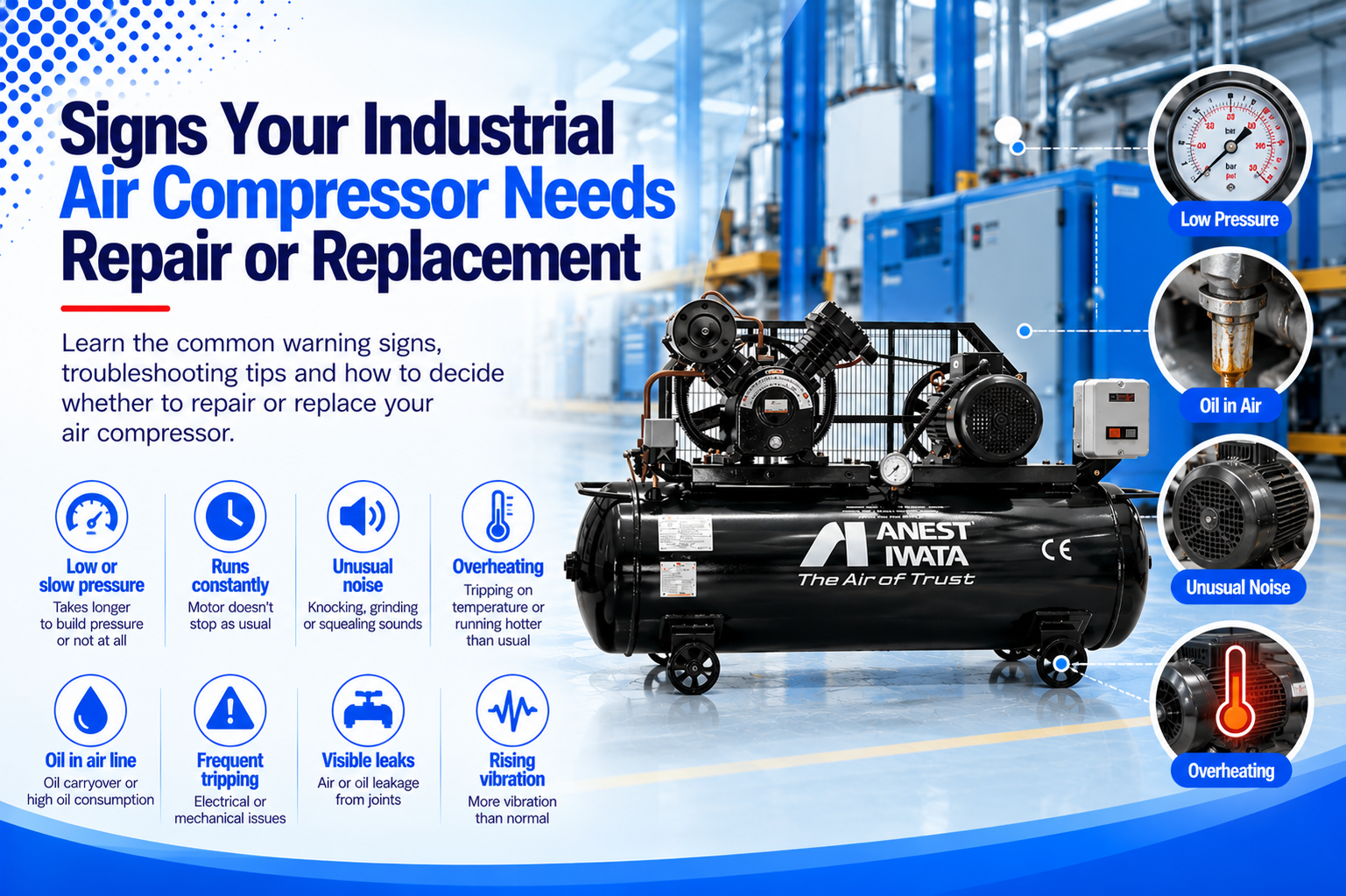
Signs Your Industrial Air Compressor Needs Repair or Replacement
Quick answer: Warning signs that an air compressor needs attention include pressure that builds slowly or not at all, a motor that runs constantly, unusual noise, overheating, oil in the air line and frequent tripping. A repair is usually sensible when the fault is isolated and parts are available. Replacement is worth considering when problems keep returning or the machine can no longer meet your air demand.
A compressor rarely fails without warning. It usually sends signals for weeks or months, in the form of small changes in sound, pressure, temperature or running time. Learning to read those signals helps you decide between air compressor repair or replacement at the right moment, instead of at a time forced on you by a breakdown. This guide explains the signs of air compressor failure, a basic troubleshooting routine and how to judge whether it is time to repair or replace.
What Are the Signs of Air Compressor Failure?
Watch for these common warning signs.
- Pressure that builds slowly, or not at all. The compressor runs but the gauge climbs slowly or stalls below normal.
- A motor that never seems to stop. If the compressor runs far longer than before to reach pressure, it is working harder for less result.
- Unusual noise. Knocking, grinding, squealing or a sudden change in sound often points to worn bearings, loose parts or valve problems.
- Overheating. A compressor that trips on temperature or feels much hotter than usual may have cooling, oil or load problems.
- Oil in the air or heavy oil use. Oil carried into the air line, or an oil level that keeps dropping, indicates a sealing or separation fault.
- Frequent tripping or hard starting. Electrical or mechanical problems can cause the motor to trip or struggle to start.
- Visible leaks. Air hissing from joints or oil dripping from the unit should be investigated.
- Rising vibration. Increased shaking can point to wear, loosened mounts or a drive problem.
One sign on its own may be minor. Several at once usually deserve a proper inspection.
Air Compressor Not Building Pressure: Common Causes
Few problems worry plant managers more than an air compressor not building pressure. Before assuming the worst, check the following common causes in order. Always switch off and release the stored pressure before opening or touching any part.
- Air leaks in the system. Leaks in pipes, hoses and couplings let air escape as fast as it is produced.
- Blocked intake filter. A clogged filter limits the air entering the compressor.
- Faulty drain valve. A stuck open drain releases air continuously.
- Worn or damaged valves. In reciprocating compressors, faulty valves allow air to leak back during compression.
- Worn piston rings or seals. These reduce the compressor’s ability to compress air effectively.
- Slipping or broken belt. Where a belt drive is used, a loose belt reduces output.
- Pressure switch or unloader faults. These can stop the compressor loading correctly.
- Demand beyond capacity. If the plant has expanded, the compressor may simply be too small.
A Basic Air Compressor Troubleshooting Routine
When a fault appears, a simple order of checks saves time.
- Note the symptom precisely. Is the pressure low, slow, unstable or absent?
- Check the obvious first. Inspect the intake filter, drain valve, belts and visible connections.
- Listen for leaks. Ask someone to check the system when production is quiet.
- Review recent changes. New machines, longer hours or a recent service may explain the change.
- Compare with your records. If you keep a logbook, compare current pressure, temperature and running hours with earlier readings.
- Stop if the cause is unclear. Do not keep running a compressor that is overheating, vibrating heavily or making new noises. Call a qualified service engineer.
Which Problems Are Usually Worth Repairing?
Repair is often the practical choice when the fault is specific, the rest of the machine is in good condition and replacement parts are available. Examples include:
- Clogged or worn filters
- Faulty drain or unloader valves
- Worn belts
- Leaking hoses, fittings and joints
- A pressure switch that needs adjustment or replacement
- Routine service items such as oil and separator elements
Many of these use consumable parts, such as filters, which can be supplied from stock. Bimpex lists filters, refrigerant dryers and air receivers on its spares, consumables and accessories page, which is a useful starting point if your fault points to a worn or clogged component.
When to Replace an Air Compressor
Knowing when to replace air compressor equipment is easier if you ask a few direct questions.
- Do the same faults keep coming back? Repeated repairs on different parts suggest the machine is wearing out overall.
- Is a major component failing? Serious damage to the compressor block or motor may not be practical to repair, depending on the model.
- Are parts still available? A compressor that cannot be supported with parts is a growing risk.
- Has your air demand grown? A unit that was right for your plant five years ago may now be undersized.
- Is it unreliable at critical times? If breakdowns hit production regularly, the downtime itself is a reason to change.
- Is it very old or out of its design life? Older machines may struggle to meet current needs.
A Quick Repair or Replace Checklist
Use this short checklist when you are unsure.
Question | Points towards repair | Points towards replacement |
|---|---|---|
Is the fault isolated? | Yes, one clear cause | No, several related faults |
Are parts available? | Yes | No or difficult to source |
How often does it fail? | Rarely | Repeatedly |
Does it meet air demand? | Yes | No, even when healthy |
What is the machine’s condition? | Generally sound | Worn throughout |
If most of your answers fall in the right hand column, it is worth planning a replacement rather than continuing with repairs.
How Can You Reduce the Risk of Failure?
Prevention is always easier than diagnosis. Keep a regular maintenance schedule, drain moisture daily, replace filters on time and track pressure and temperature in a simple logbook. Address small leaks as soon as they are found, and make sure the compressor room is clean and well ventilated. These steps do not make a compressor last forever, but they remove many avoidable causes of early failure.
Frequently Asked Questions
How do I know if my air compressor is failing?
The common signs are slow or no pressure build up, a motor that runs constantly, unusual noises, overheating, oil in the air and frequent tripping. Several of these together should prompt a professional inspection.
Why is my air compressor not building pressure?
Common causes include air leaks, a blocked intake filter, a stuck drain valve, worn valves or piston rings, a slipping belt or a faulty pressure switch. Check the simple items first, with the compressor switched off and depressurised.
When should an industrial air compressor be replaced?
Consider replacement when repairs recur, major components are failing, parts are hard to find or your air demand has outgrown the machine.
Is it safe to keep running a compressor that makes strange noises?
Not for long. New knocking, grinding or squealing can mean a developing mechanical fault. Stopping early often limits the damage.
Can a worn compressor be repaired instead of replaced?
Sometimes. If the problem is limited to replaceable parts such as valves, filters, belts or seals, repair is often practical. Widespread wear usually points towards replacement.
Conclusion
Compressors give warning before they fail, and the plants that notice the signs earliest have the most options. Watch for changes in pressure, noise, temperature and running time, work through a basic troubleshooting routine and use the repair or replace checklist when a fault appears. If you need filters, dryers or other spares to support a repair, you can enquire with the Bimpex team.